
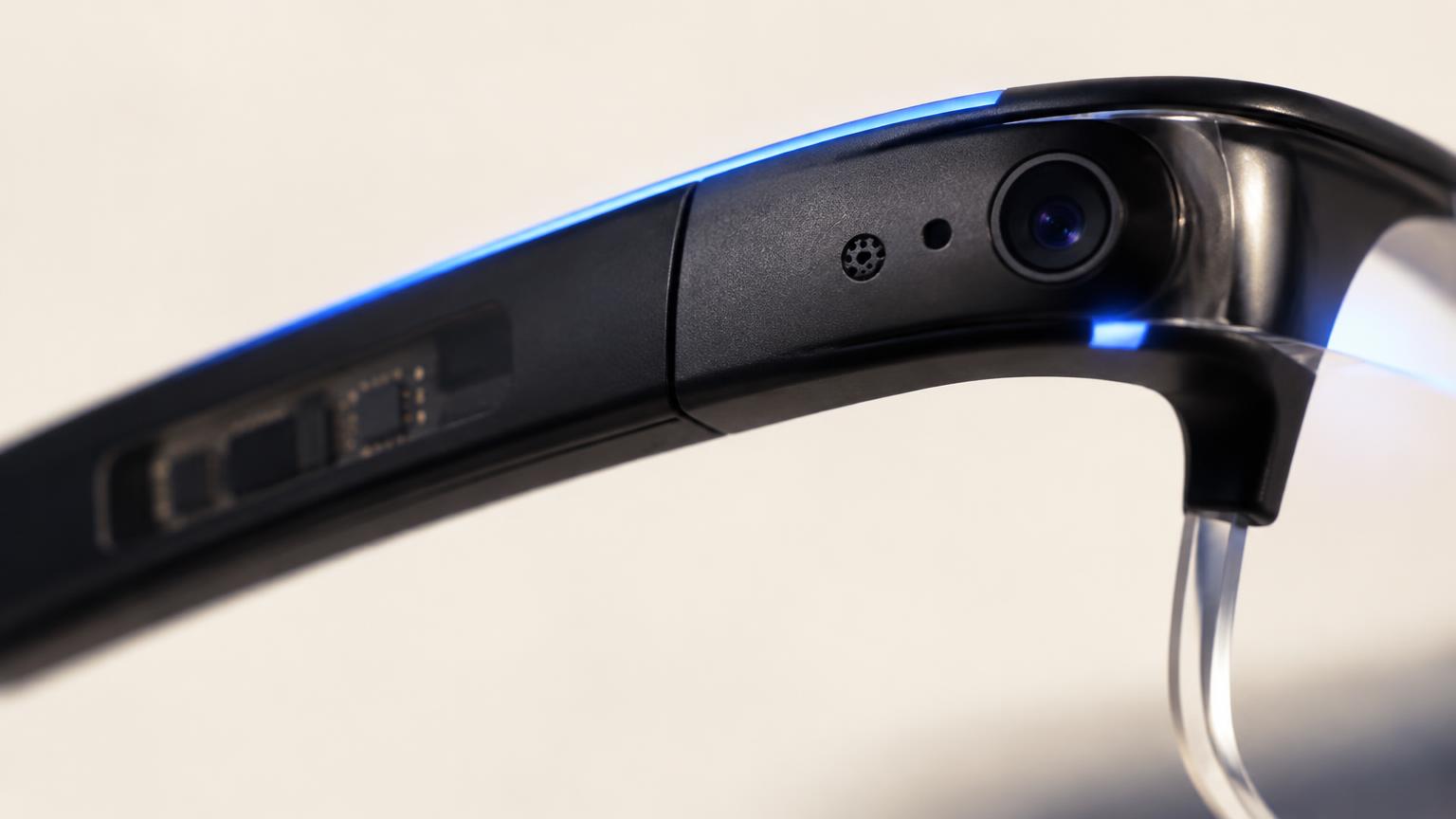
What is inside the frame
A modern pair packs a surprising amount into two temple arms: a low-power processor, Bluetooth and Wi-Fi radios, a battery in each arm, a few microphones, open-ear speakers aimed at your ears rather than into them, touch sensors, and — on camera models — a small image sensor beside one hinge. Display models add a light engine and an optical element that steers light into your eye. Everything has to fit inside a shape that still reads as eyewear, which is why weight is measured in grams and why every feature costs battery.
How the AI assistant actually answers you
You say a wake word. The microphones are already listening for that specific pattern locally, so nothing is sent anywhere until it matches. Then your speech — and on camera models a still image of what you are looking at — travels over Bluetooth to your phone, which forwards it to a large model in the cloud. The answer comes back as text or synthesised speech and plays through the open-ear speakers. That round trip is why answers take a second or two, and why glasses without a phone connection can do far less.
How the camera and capture work
The camera is a fixed-focus wide-angle module tuned for the middle distance, because there is no room for a mechanical zoom and no time to hunt for focus. You trigger it with a button, a touch gesture or a voice command; photos and video are stored on the glasses and synced to your phone later over Wi-Fi, which is faster than Bluetooth but drains the battery. A capture indicator light is a hardware feature, not a software one, on any reputable consumer model.
How the display works when there is one
Display glasses do not put a screen in front of your eye. A tiny light engine — usually microLED or micro-OLED — generates a bright image at the edge of the frame, and a waveguide inside the lens bounces that light through the glass and releases it toward your pupil. Because the waveguide is transparent, you see the world and the image at once. The trade-offs are inherent: brightness competes with daylight, colour is hard to produce efficiently, and the waveguide constrains how the lens can be curved, which is why prescription support on display models is tighter.
How you control them
There is no keyboard, so input is layered. Voice handles anything complex. A touch surface on the temple handles volume, playback and answering calls. Head gestures handle dismissing a notification. Some display frames add a ring, a wristband reading muscle signals, or a phone app for anything that needs real typing. Good smart glasses make the common actions possible without touching your phone and accept that the rare ones will need it.
Where the battery goes
Idle standby costs almost nothing; the expensive operations are radios and light. Streaming audio, recording video, running the display and syncing over Wi-Fi are what turn an all-day standby figure into three or four hours of real use. That is why manufacturers quote standby time, why the charging case is part of the product rather than an accessory, and why camera-free frames with simple monochrome displays consistently last longer than camera-and-display models.
How prescription lenses fit into this
On audio and camera models, the lens is an ordinary lens — an optician grinds your prescription and fits it to the frame like any other pair. On display models the lens is also part of the optical path, so your correction has to coexist with the waveguide. That is done either by bonding the prescription to the waveguide or by adding a prescription insert behind it, and both approaches have real power limits that vary by model and market.
Frequently asked questions
Lenscript is an independent information platform. It does not provide medical advice — prescription and lens decisions should be confirmed with a qualified optician or eye-care professional.